INTERPERSONAL LANDSCAPES[1]
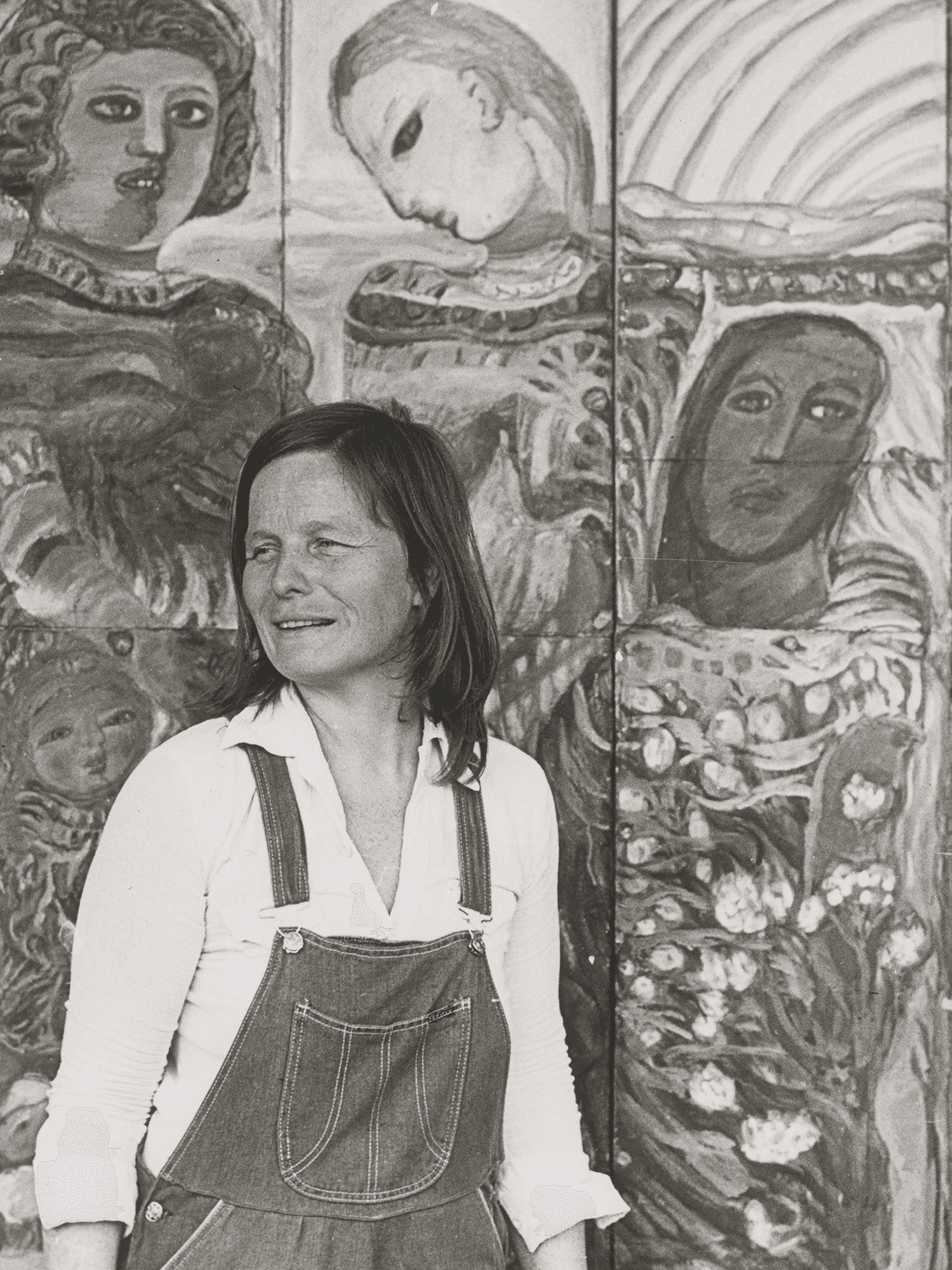
The first chapter is dedicated to Annemirl Bauer’s portraits, her mother-child motifs, and her depictions of relationships with others and with herself. Through their polylogue, the works create an intimate and private space, at the center of which stands one of the primary themes of Bauer’s artistic work: the question of what it means to be human. The human figure in all its facets has shaped Bauer’s image worlds. As early as 1965, in her thesis Das neue Menschenbild [The New Image of Humanity], submitted to the Hochschule für bildende und angewandte Kunst in Berlin-Weissensee, she wrote: “The true path of art is found when one strives to be a person who knows that they can live and be happy only with and through other people.”[2]
Her motifs were primarily familiar people: children from the neighborhood in Prenzlauer Berg and in the countryside,[3] her daughter Amrei, her mother, friends, and neighbors, but also café customers or people whom she met while traveling. Through Bauer’s particular talent for observation, everything and everyone she encountered became part of her artistic cosmos. She looked carefully and took in the person standing before her; “she sought to capture entire life stories.”[4] She was tolerant toward other lifestyles, had a deep “trust in her own imagination,”[5] and created fantasy worlds—alternatives to the restrictive system that she was subjected to.
Many of the paintings are consciously distorted, characterized by powerful contours, strong forms, and expressive brushstrokes and lines. Many also attest to Bauer’s inventive use of color. For this reason, and because they resolutely defy iconographic interpretations, they seem timeless, enigmatic, and deeply compelling.
Bauer’s depictions of arguing or amorous couples are impressive. She portrays them without regard for traditional and normative conceptions of relationships, and it is precisely this approach that invites viewers to critically question those very conventions. To this end, the artist renders them in numerous small-format drawings with thin lines and reduced contours, which suffice to make the intimacy and closeness visible, but also the tension. A gouache on paper rendered in blue and earthtones depicts two faces whose profiles meld into one another. Here, Bauer used the recurring motif of the spiral, which connects the inner with the outer world and can represent connection, movement, life, and cosmic order. She pairs this motif with a poison cloud to create a visual distillation of universal themes like love, intimacy, fusion, dependence, and loss, as well as humanity’s relationship to nature and the environment—and the destruction it wreaks on both.
Many of Bauer’s paintings, collages, and drawings depict mother-child motifs or self-portraits. These works explore her identity as a woman and mother, motherhood in all its facets, and her self-discovery within these roles. Works like "Nicht eines Lebens kunstgetriebene Schale… (Frauen, meiner Mutter gewidmet)" [Not the Art-Driven Shell of a Life… (Women, Dedicated to my Mother)] from the 1980s, "Loslösung" [Breaking Away] (n.d.), or "Aus der Mutter die Tochter der weibliche Geist gefürchtet die Frucht und getötet vom Mann" [From the Mother The Daughter The Feared Female Spirit The Fruit and Killed by Man] (n.d.) express existential feelings and experiences like deep connection, vulnerability, fear of loss, intimacy, differentiation, and cutting the cord. At times, Bauer takes up the rich visual tradition of Christian depictions of Mary, deconstructing them to generate an intimate, introspective, and contemporary moment. In other drawings, it is a single line that closely connects multiple faces and bodies in fine flourishes, loops, and sometimes spirals. That Bauer made these drawings without ever setting aside her pen imbues them with a surprising sense of stability. She thus situates her depicted subjects in an intimate protected space, while also allowing them to separate from one another. Even this capacity for distance breaks with the traditional iconography of motherhood as an institution.[6] She replaces the one-dimensional figure of the woman as child bearer, caregiver, protector, and humble helpmate with an image of mothers as complex, multifaceted figures. In doing so, she joins a group of remarkable modern women artists like Paula Modersohn-Becker, Käthe Kollwitz, Louise Bourgeois, Alice Neel, and Miriam Cahn who free our conceptions of motherhood from (art) histories and visual cultures primarily written from a male perspective, instead developing counter-images shaped by women’s perspectives and more diverse histories.[7]
[1] The title of this chapter of the exhibition is based on a quote by artist Annemirl Bauer: “Now it’s
the very walls, broken through between people, as well as the hopeful expanses and open spaces that I want to experience and make palpable. So for me it’s about the interpersonal landscape there and here at home.” Christiane Müller, “Feminismus, Frankreich, Fandarole. Christiane Müller im Gespräch mit Annemirl Bauer,” in: Asteris Kutulas (ed.), Bizarre Städte, special issue 1, Berlin 1989, pp. 51–57, here p. 57. Trans. for the exh. cat.
[2] Annemirl Bauer in an excerpt from her thesis work, in: Kristina Volke (ed.), In meinem eigenen Lande. Die Malerin und Dissidentin Annemirl Bauer, exh. cat. Deutscher Bundestag, Berlin 2012, pp. 29–117, here p. 35.
[3] In 1976, Annemirl Bauer moved with her then seven-year-old daughter into an old parsonage in Brandenburg that was in need of renovation. Bauer retreated there in search of nature and a studio space, and to escape—at least temporarily—the increasing reprisals from the SED. Previously, Annemirl Bauer had lived and worked on Helmholtzplatz in Berlin’s Prenzlauer Berg district, in an old, modest storefront apartment that also served as a living space for her and her daughter.
[4] “‘In our fantasy, thoughts and opinions are free.’ A conversation between Amrei Bauer and Marie Gerbaulet,” in: Marie Gerbaulet, Anna Schneider (eds.), Annemirl Bauer: A Rupture in the World, exh. cat. DAS MINSK Kunsthaus in Potsdam, Berlin 2026, pp. 170–180, here p. 172.
[5] Ibid., p. 180.
[6] Motherhood as an institution is a central concept in the work of US-American feminist, poet, professor, and author Adrienne Rich, particularly in her book Of Woman Born (1976).
[7] These thoughts were inspired by the 2025 publication Mothering Myths—An ABC of Art, Birth and Care, edited by Laurie Cluitmans, which includes the essay “Beyond the Madonna” by Rosemarie Buikema.